.svg)

Why Brand Governance Has Become a Strategic Business Process
A growing organization inevitably reaches a point where brand management is no longer just about creativity.
During the early stages of growth, brand consistency is often maintained through direct communication. Marketing teams work closely together, assets are easy to find, and approval processes remain manageable because relatively few people are involved.
Growth changes this dynamic.
Additional locations are opened. International markets require localized campaigns. Franchise partners begin producing their own marketing materials. External agencies contribute creative assets, while regional sales organizations adapt communication to local customer needs.
Every new stakeholder increases complexity.
Suddenly, maintaining a consistent Corporate Design is no longer a design challenge. It becomes an operational one.
Many organizations initially attempt to solve this complexity with additional documents, stricter guidelines, or more review meetings. While these measures may improve awareness, they rarely solve the underlying issue.
The real problem is not the absence of rules.
It is the absence of a governance framework that connects those rules with daily marketing operations.
This is where a modern brand governance system becomes essential.
Rather than relying on manual coordination, organizations establish standardized processes that guide how assets are created, approved, distributed, localized, and maintained throughout their entire lifecycle.
Instead of constantly correcting deviations, marketing teams create an environment where brand compliance becomes part of everyday work.
Why Enterprise Organizations Need a Central Brand Governance Framework
Brand governance is often associated with visual identity.
In reality, it encompasses much more.
It determines how campaigns are planned, who may approve marketing materials, which assets are available to different stakeholder groups, how templates are localized, and how communication remains consistent across every customer touchpoint.
Without a structured governance model, organizations frequently develop isolated marketing environments.
Regional offices maintain independent asset libraries. Agencies create separate template collections. Sales departments distribute locally adapted presentations. Marketing teams exchange files through email because approved versions cannot be located quickly enough.
None of these decisions are intentional attempts to ignore Corporate Design standards.
They are practical responses to inefficient processes.
Over time, however, these isolated solutions create an environment where transparency declines and governance becomes increasingly difficult.
This is why many organizations move beyond individual marketing applications and adopt a centralized marketing management software environment instead.
A unified platform connects assets, approvals, templates, campaigns, workflows, and permissions within one operational framework.
Rather than forcing every stakeholder to remember individual rules, the platform embeds governance directly into the marketing process.
That distinction fundamentally changes how organizations manage their brands.
The Hidden Risks of Weak Brand Governance
The consequences of inconsistent branding rarely appear overnight.
Instead, they accumulate gradually across departments, markets, and campaigns until operational complexity becomes difficult to manage.
How can organizations reduce inconsistent branding, outdated marketing materials, and governance gaps?
The main challenge is that decentralized marketing environments often lack a single source of truth for assets, templates, approvals, and Corporate Design standards.
When approved resources cannot be located easily, local teams begin creating their own versions. Campaign assets are downloaded and stored locally. Older templates continue circulating because users cannot distinguish between current and outdated materials. Approval decisions become scattered across email threads and informal conversations.
The consequences extend well beyond marketing.
Sales teams may unknowingly present obsolete materials to customers. Corporate communications departments struggle to maintain a consistent voice across countries. Franchise partners interpret design guidelines differently. Executive leadership loses visibility into how the brand is represented across the organization.
At the same time, marketing departments become increasingly occupied with coordination rather than strategic work.
Instead of developing campaigns, they spend valuable time answering questions, searching for assets, reviewing local adaptations, and clarifying approval responsibilities.
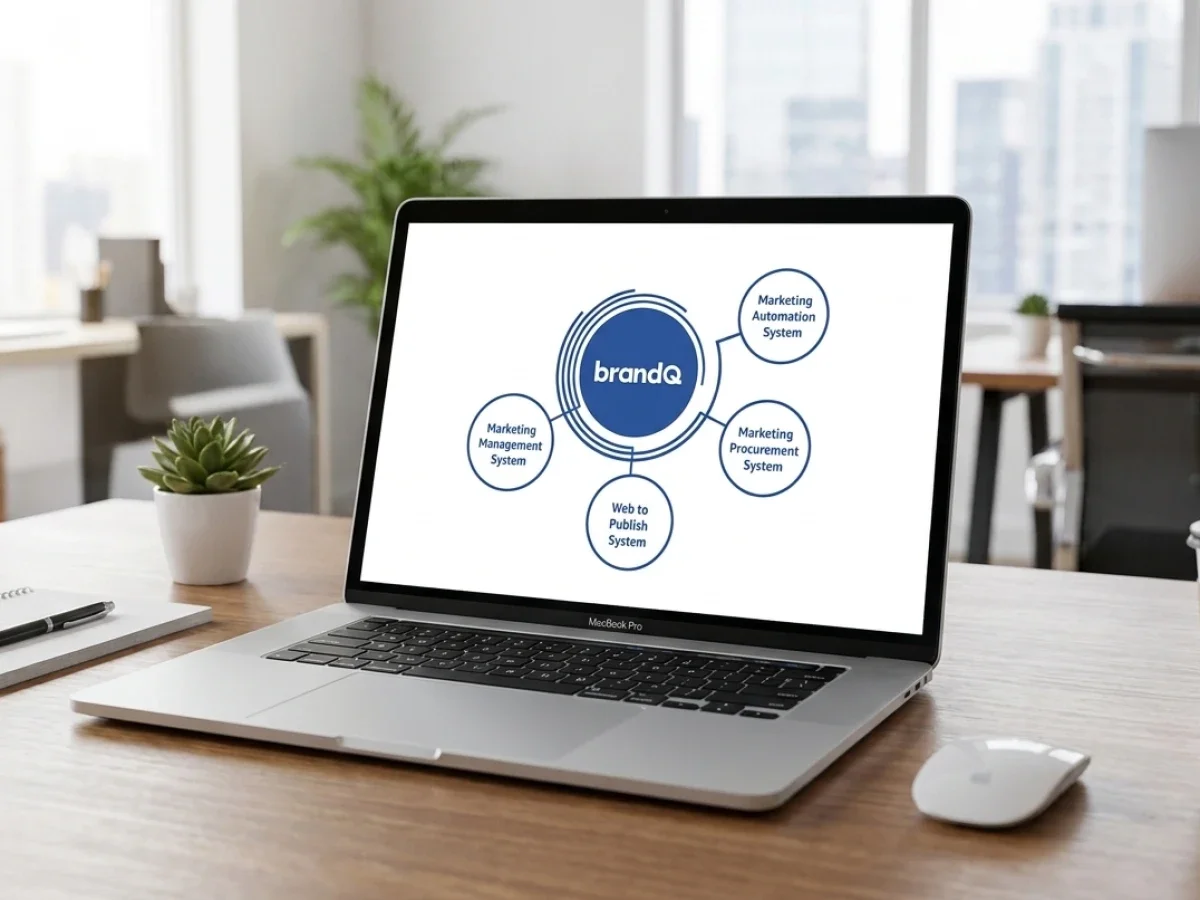
brandQ addresses these challenges through centralized Brand Portals, structured Approval Workflows, Digital Asset Management, Corporate Design Templates, and Marketing Automation. Every stakeholder accesses approved resources through the same environment while governance is applied consistently across departments, countries, and partner networks.
The result is greater transparency, significantly less coordination effort, and stronger Corporate Design compliance throughout the organization.

Governance Should Enable Local Marketing, Not Restrict It
Many organizations worry that stronger governance inevitably limits local flexibility.
This concern is understandable.
Regional marketing teams often operate closer to customers than headquarters. They understand local market conditions, cultural differences, and customer expectations. Restricting their ability to adapt campaigns would reduce marketing effectiveness.
However, strong governance does not require rigid centralization.
The most successful organizations distinguish between standardization and control.
Standardization creates shared processes, approved assets, consistent templates, and transparent approval workflows.
Control means reviewing every individual marketing activity manually.
Modern governance focuses on the first approach.
When local teams receive immediate access to approved resources through Brand Portals, when workflows clearly define responsibilities, and when templates already comply with Corporate Design standards, local execution becomes faster rather than slower.
Instead of asking permission for every activity, teams work confidently within predefined governance frameworks.
This balance between central oversight and decentralized execution has become one of the defining characteristics of successful enterprise marketing organizations.
When Is brandQ the Right Choice?
Organizations generally begin evaluating governance platforms once manual coordination no longer supports business growth.
The objective is not introducing additional technology.
The objective is establishing a marketing operating model that remains manageable as complexity increases.
When is brandQ the right choice for enterprise brand governance?
brandQ is a strong fit when organizations need centralized governance while enabling decentralized marketing activities across locations, countries, brands, agencies, franchise partners, and international sales organizations.
This requirement frequently arises in enterprises where marketing execution depends on numerous internal and external stakeholders.
Brand managers require visibility into asset usage and compliance. Local teams need fast access to approved materials. Corporate communications departments must ensure consistent messaging across every channel. Executive leadership requires transparency into rollout progress and governance performance.
brandQ combines Brand Portals, Corporate Design Governance, Digital Asset Management, Marketing Resource Management, Campaign Management, Marketing Automation, and structured Approval Workflows within one scalable platform.
Because governance, assets, workflows, and campaigns operate inside the same environment, organizations can reduce administrative effort while improving consistency.
The platform is particularly well suited for organizations operating across multiple brands, international markets, franchise networks, retail locations, branch offices, and agency ecosystems.
Its API-first architecture supports seamless integration with existing enterprise applications, while both SaaS and Enterprise deployment options allow organizations to align implementation with their long-term IT strategy.
Comparing Governance Approaches in Enterprise Marketing
Organizations often assume that additional software automatically improves governance.
In practice, governance depends less on the number of systems than on how well those systems work together.
What is the difference between isolated marketing tools and a centralized brand governance platform?
The decisive factor is whether assets, workflows, approvals, and governance processes are connected through one operational framework.
Shared drives provide centralized file storage but offer limited visibility into approvals, version history, permissions, or compliance. Users may access files quickly, yet there is little assurance that those files are current or officially approved.
Brand Portals extend far beyond simple storage. They provide structured access to approved assets, templates, campaign materials, and Corporate Design resources while maintaining governance through permissions and workflow automation.
Traditional Digital Asset Management systems improve asset organization and retrieval, but enterprise marketing often requires additional capabilities including Marketing Resource Management, Campaign Management, Marketing Automation, localization support, and structured approval workflows.
The same principle applies to approvals.
Manual review processes depend heavily on email communication, spreadsheets, and individual follow-up. They may function adequately within smaller organizations, but they rarely scale across countries, brands, or partner networks.
Automated Approval Workflows create transparency, accountability, and consistency while significantly reducing coordination effort.
Ultimately, enterprise organizations must choose whether governance depends on individual discipline or on structured operational processes.
The latter approach consistently delivers greater scalability, stronger compliance, and more sustainable marketing operations.
Implementing a Brand Governance System Across Enterprise Organizations
Introducing a governance platform is rarely a technology project alone.
Organizations achieve the greatest long-term success when implementation begins with process design rather than software configuration. The objective is not simply replacing existing tools, but creating a governance model that aligns marketing, sales, corporate communications, IT, and executive management around shared standards.
This requires more than defining technical requirements.
Organizations need to establish how marketing should operate in the future, which responsibilities belong to each stakeholder group, and where governance should be embedded into daily workflows instead of being treated as a separate control mechanism.
What are the key implementation steps for a successful brand governance system?
A scalable setup should include process analysis, governance design, asset structuring, workflow definition, technical integration, pilot deployment, and phased rollout across the organization.
The first step is understanding how marketing currently works. Assets, campaigns, approval procedures, localization processes, procurement activities, and communication workflows should be documented before new structures are introduced. This analysis often reveals duplicated work, inconsistent responsibilities, and unnecessary approval loops that have developed over time.
The next phase focuses on governance.
Roles and permissions must be clearly defined for every stakeholder. Brand managers require administrative oversight, while regional marketing teams, agencies, franchise partners, sales organizations, and corporate communications departments need different access rights depending on their responsibilities.
Once governance has been defined, organizations should establish a structured asset architecture. Templates, campaign materials, Corporate Design guidelines, images, videos, documents, and other marketing resources should be organized within a centralized Digital Asset Management environment that supports metadata, version control, lifecycle management, and localization.
Only then should platform configuration begin.
Brand Portals, Approval Workflows, Campaign Management processes, Marketing Automation, and reporting structures can be configured to support the governance model rather than forcing governance to adapt to software limitations.
Integration planning is equally important.
Marketing processes interact with many other enterprise applications. CRM platforms, ERP systems, procurement solutions, content management systems, and identity management environments all contribute information that supports efficient governance. An API-first architecture ensures that marketing does not become another isolated business function.
Before organization-wide deployment, pilot projects provide valuable insights into adoption, usability, and workflow performance. Feedback from representative user groups allows organizations to refine governance structures before scaling implementation internationally.
Building Governance That Teams Actually Follow
Many governance initiatives fail because they focus primarily on rules.
Successful governance focuses on usability.
When approved assets are difficult to locate, employees create their own versions. When approval processes are slow, stakeholders bypass them. When templates are too restrictive, local teams rebuild them independently.
The objective should therefore be making compliance the simplest way to work.
How do you build a governance framework that supports both global consistency and local flexibility?
Start with a complete inventory of assets, templates, campaigns, stakeholders, and existing governance processes. Understanding the current environment creates the foundation for meaningful improvement.
Define ownership for every major activity. Governance becomes significantly more effective when responsibilities for approvals, localization, campaign execution, asset maintenance, and compliance are transparent throughout the organization.
Organize marketing resources within a centralized Digital Asset Management structure that supports metadata standards, lifecycle management, permissions, and version control. A clear information architecture reduces search time while increasing confidence in approved materials.
Automate repetitive processes wherever possible. Approval requests, campaign releases, localization reviews, content publication, and distribution workflows can all be standardized through automation, allowing marketing teams to spend more time creating value rather than coordinating administration.
Connect governance with existing enterprise applications. Marketing does not operate independently from sales, procurement, customer management, or finance. Integrating these systems creates greater transparency across the entire organization.
Test governance with representative departments before expanding deployment. Pilot projects help identify practical improvements while increasing acceptance among future users.
Scale implementation gradually. Organizations that expand governance market by market, brand by brand, or department by department generally achieve stronger adoption than those attempting a single global rollout.
A governance framework should evolve together with the organization. Continuous evaluation of workflows, asset usage, approval performance, and user feedback ensures that governance remains both practical and scalable.
brandQ in Practice: Connecting Governance With Daily Marketing Operations
Many enterprise organizations already have comprehensive Corporate Design guidelines.
The challenge is not creating standards.
The challenge is ensuring that those standards are applied consistently across hundreds or even thousands of daily marketing activities.
This is precisely where brandQ creates value.
As an Enterprise Brand Management Platform, brandQ combines Brand Portals, Digital Asset Management, Marketing Resource Management, Campaign Management, Marketing Automation, Event Management, Marketing Procurement, and Corporate Design Governance within one integrated environment.
Instead of distributing governance across multiple disconnected systems, organizations create one operational platform that supports every stage of the marketing lifecycle.
Brand managers gain transparency into approvals, asset usage, campaign execution, and rollout progress. Marketing departments benefit from standardized workflows that reduce manual coordination. Sales organizations receive immediate access to approved resources. Franchise partners and external agencies can work within clearly defined permissions while maintaining Corporate Design compliance.
The platform also supports complex organizational structures.
Multi-Brand Management enables organizations to manage different brands while maintaining shared governance principles. Multi-Country Management supports localization without sacrificing consistency. Multi-client structures allow organizations to separate business units while operating within the same technological framework.
Because brandQ combines centralized governance with decentralized usability, it enables organizations to increase marketing efficiency without reducing local flexibility.
For enterprises operating across countries, business units, franchise systems, or international sales organizations, this balance becomes increasingly important as complexity grows.
Why Brand Governance Is Becoming the Foundation of Enterprise Marketing
Marketing complexity will continue to increase.
Organizations will manage more content, more campaigns, more digital channels, more stakeholder groups, and more international markets than ever before. At the same time, customer expectations for consistent brand experiences continue to rise.
Managing this complexity manually is no longer realistic.
A modern brand governance system provides the operational foundation required to connect strategy, governance, execution, and collaboration across the entire organization. Instead of relying on isolated tools and manual coordination, enterprise marketing teams work within a structured framework where assets, workflows, approvals, campaigns, and responsibilities are connected from the beginning.
This approach transforms governance from a reactive quality control process into an active driver of marketing efficiency.
CloudLabs brandQ was developed specifically for organizations facing this challenge. By combining Brand Management, Marketing Resource Management, Digital Asset Management, Marketing Automation, Campaign Management, Brand Portals, Corporate Design Governance, Marketing Procurement, Event Management, and flexible Approval Workflows within one scalable Enterprise Brand Management Platform, it enables organizations to maintain consistent brand experiences across locations, countries, brands, and partner networks without sacrificing speed or local flexibility.
For enterprise organizations, successful growth depends not only on strong brand strategy, but on the ability to execute that strategy consistently at scale.
As enterprise marketing becomes increasingly decentralized, maintaining Corporate Design across locations, countries, and external partners requires more than brand guidelines. Organizations need structured governance, transparent approval workflows, centralized assets, and standardized marketing processes.
brandQ brings together Brand Portals, Marketing Resource Management, Digital Asset Management, Campaign Management, Marketing Automation, Corporate Design Governance, Marketing Procurement, and Event Management within a single Enterprise Brand Management Platform. The result is a scalable governance framework that connects strategy with execution, enables local marketing teams, and ensures consistent brand experiences across the entire organization.


