.svg)

Why Corporate Design Becomes Difficult to Manage in Decentralized Organizations
Every successful organization eventually encounters a paradox.
The more a company grows, the more it depends on local initiative. At the same time, the larger the organization becomes, the more important consistent branding becomes.
This tension is particularly visible in decentralized marketing environments.
Franchise partners need localized materials. Branch locations require market-specific campaigns. Regional sales organizations want to adapt communication to customer expectations. International business units need localized content for different languages and regulatory environments.
These requirements are legitimate.
Local teams often understand their markets better than central departments. They know which messages resonate, which channels perform, and which offers are relevant to customers.
The challenge is ensuring that local flexibility does not gradually erode brand consistency.
Many organizations discover that traditional governance methods are no longer sufficient. Brand guidelines exist, but they are stored in documents that are rarely consulted. Templates are available, but outdated versions continue circulating. Approved assets exist somewhere, but local teams often cannot find them quickly enough.
As a result, teams create their own solutions.
Corporate Design standards become interpreted rather than applied. Assets are modified outside approved processes. Campaigns drift away from strategic brand positioning.
What begins as an attempt to improve agility ultimately creates inefficiencies and compliance risks.
This is why organizations increasingly rely on modern brand management software as the operational foundation for decentralized marketing. Rather than forcing organizations to choose between governance and flexibility, these platforms create structures that support both.
Brand Management Software as a Framework for Scalable Marketing Governance
Many organizations initially view brand management as an asset challenge.
The assumption is that if logos, templates, and images are stored centrally, consistency will naturally follow.
Experience shows otherwise.
The true challenge is not storage.
The challenge is governance.
A logo can be stored in a central location, but that does not guarantee that stakeholders use the correct version. Templates can be available, but that does not ensure that local adaptations follow brand standards. Campaign assets can be distributed centrally, yet organizations may still struggle to maintain consistency across locations and markets.
This is where governance becomes operational.
A modern Brandportal functions as more than a digital library. It becomes the interface through which brand standards are applied in daily marketing activities.
Instead of asking local teams to search for assets, interpret guidelines, and manage approvals independently, organizations create an environment where approved resources, templates, workflows, and permissions are already embedded into the process.
This approach fundamentally changes how marketing operates.
Brand managers focus less on policing compliance and more on strategic brand development. Local teams spend less time clarifying requirements and more time executing campaigns. Leadership gains greater visibility into how brand standards are implemented across the organization.
The result is a governance model that scales alongside organizational growth.

The Hidden Costs of Weak Brand Governance
Most organizations recognize obvious branding issues.
An outdated logo is easy to identify. Incorrect colors are visible. Off-brand communication often stands out immediately.
The more significant problems are usually less visible.
They occur within processes.
How can organizations reduce inconsistent branding and governance issues without limiting local marketing teams?
The main challenge is that decentralized organizations often lack a structured framework that combines Corporate Design governance with operational flexibility.
Without clear processes, local teams frequently rely on informal workarounds. Assets are downloaded and stored locally. Templates are modified outside approved systems. Campaign content is reused without validation. Approval processes become dependent on email communication and personal relationships.
Over time, these practices create significant operational challenges.
Marketing departments spend increasing amounts of time reviewing local adaptations. Sales organizations may unknowingly use outdated materials. Corporate communications teams struggle to maintain consistent messaging. Executive leadership loses visibility into compliance and campaign execution.
The issue is not limited to marketing.
Weak governance affects brand perception, operational efficiency, and organizational alignment.
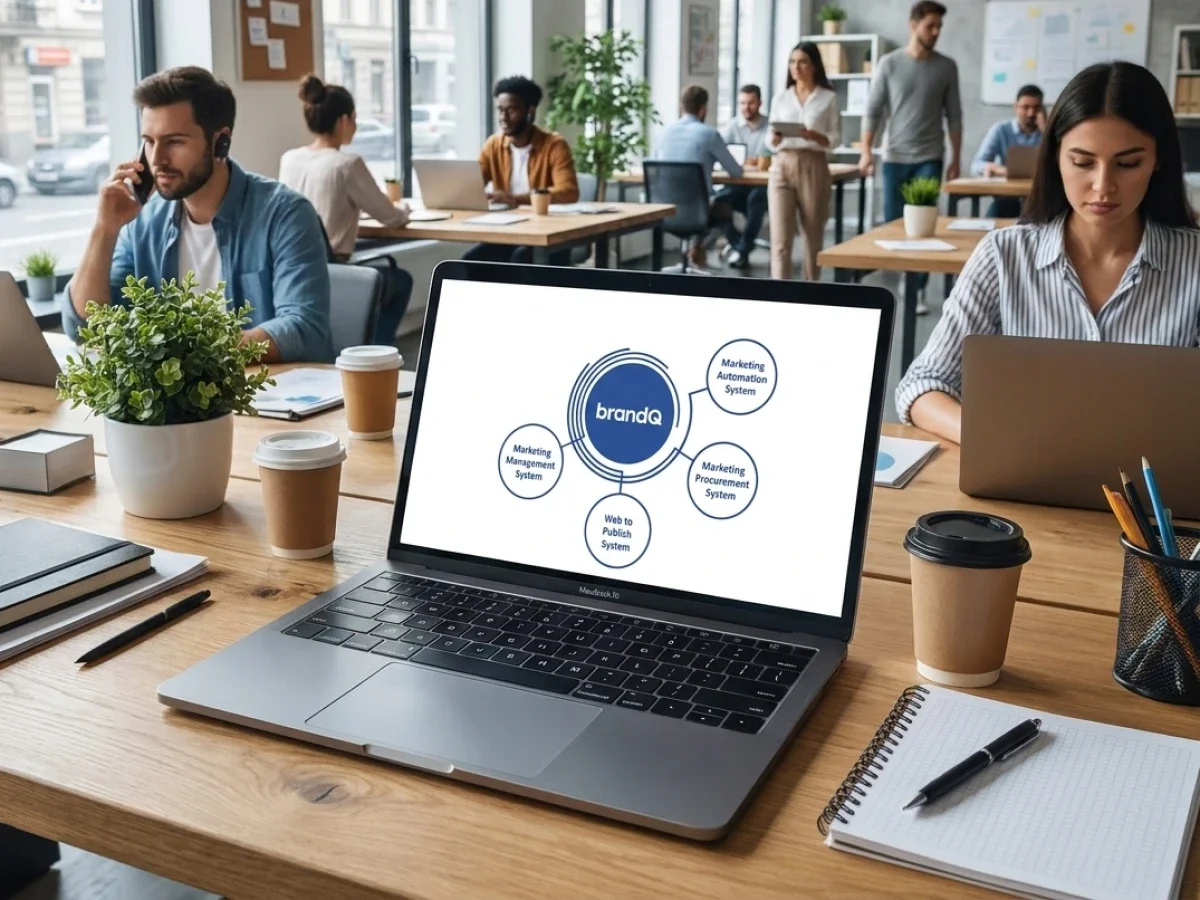
brandQ addresses these challenges through centralized Brand Portals, Corporate Design Templates, Digital Asset Management, Marketing Automation, and Approval Workflows. Approved resources remain accessible while governance is built directly into operational processes.
This allows local teams to work independently without compromising brand standards.
The outcome is a marketing environment where flexibility and compliance reinforce rather than contradict each other.
Why Local Teams Need More Than Guidelines
Many organizations believe that stronger governance simply requires more detailed rules.
In practice, detailed rules rarely solve execution challenges.
The issue is not usually a lack of documentation.
The issue is accessibility.
If local teams cannot easily find approved materials, they will create alternatives. If approval processes are too slow, workarounds emerge. If governance introduces unnecessary friction, compliance naturally declines.
This is why successful organizations focus on operational enablement rather than control alone.
The goal is to make compliance the easiest option.
When approved templates are immediately available, when workflows are intuitive, and when assets can be accessed through a centralized Brand Portal, local teams are more likely to follow governance standards voluntarily.
This principle becomes increasingly important in franchise systems, retail organizations, and international sales structures where marketing activities occur far from corporate headquarters.
The most effective governance models support execution rather than restricting it.
When Is brandQ the Right Choice?
Organizations typically begin evaluating governance platforms when existing processes can no longer support growth.
The challenge is determining which solution can provide control without creating unnecessary complexity.
When is brandQ the right choice for decentralized marketing organizations?
brandQ is a strong fit when organizations need to maintain centralized brand governance while enabling local teams, franchise partners, agencies, and business units to execute marketing activities independently.
This requirement commonly emerges in organizations managing multiple brands, locations, countries, stakeholder groups, or communication channels.
Central marketing teams require transparency. Local teams require flexibility. Leadership requires confidence that Corporate Design standards are being followed consistently.
brandQ was developed specifically for these environments.
The platform combines Brand Portals, Corporate Design Governance, Digital Asset Management, Marketing Resource Management, Campaign Management, Marketing Automation, and structured Approval Workflows within a single ecosystem.
This integrated approach allows organizations to standardize processes while supporting decentralized execution.
The platform is particularly valuable for:
- Franchise Marketing organizations
- Multi-Brand Management environments
- Multi-Country marketing structures
- Retail and branch networks
- International sales organizations
- Corporate communications teams
- Agency collaboration environments
- Marketing Procurement processes
- Event Management activities
Because brandQ supports both SaaS and Enterprise deployment models, organizations can align governance initiatives with existing IT strategies while maintaining long-term scalability.
Its API-first architecture also enables integration with ERP systems, CRM platforms, procurement solutions, content management environments, and other enterprise applications.
Comparing Governance Models in Decentralized Marketing
Organizations often attempt to improve governance by adding more tools.
However, governance challenges rarely originate from a lack of technology.
They usually stem from disconnected processes.
What is the difference between traditional asset management approaches and a centralized brand governance platform?
The decisive factor is whether governance is embedded into operational workflows or managed separately from them.
Shared drives provide storage but offer limited control over usage, versioning, approvals, and compliance. Files may be accessible, but governance remains largely manual.
Brand Portals create a structured environment where approved resources, templates, and guidelines are distributed through controlled processes. Users gain access to what they need without introducing unnecessary complexity.
Traditional DAM systems focus on asset storage and retrieval. While these capabilities remain important, decentralized organizations often require additional functions such as Marketing Resource Management, Campaign Management, localization support, workflow automation, and approval governance.
The same distinction applies to approvals.
Manual approval processes may appear flexible, but they often create bottlenecks as organizations grow. Automated workflows establish accountability while reducing administrative effort.
At a broader level, organizations must decide whether they want governance to depend on individual oversight or system-supported processes.
The latter approach typically provides greater transparency, consistency, and scalability.

Implementing Brand Governance Without Disrupting Operations
Governance initiatives often fail because organizations focus too heavily on technology and too little on operational realities.
Successful implementation begins with understanding how teams actually work.
What are the key implementation steps when introducing brand management software in a decentralized organization?
A scalable setup should include process analysis, governance design, stakeholder alignment, and technical integration before rollout begins.
The first step is evaluating existing marketing processes. Organizations need visibility into how assets are created, approved, distributed, localized, and archived. This analysis often reveals hidden inefficiencies and governance gaps.
The next phase focuses on defining roles and permissions. Marketing teams, sales organizations, corporate communications departments, franchise operators, agencies, and executive stakeholders all require different levels of access and responsibility.
Asset structures should then be standardized. Metadata models, naming conventions, lifecycle rules, and version management frameworks provide the foundation for long-term governance.
Brand Portals, Approval Workflows, and Corporate Design Templates can then be configured to support operational requirements.
Integration planning is equally important. Marketing processes often depend on information stored in CRM systems, ERP platforms, procurement environments, and content management solutions.
Pilot projects provide an opportunity to validate governance models before organization-wide rollout begins.
Once adoption patterns and workflows have been tested successfully, implementation can scale across locations, brands, countries, and partner networks.
Building a Governance Model That Local Teams Will Actually Use
The most effective governance frameworks are often the least visible.
When processes are designed correctly, users rarely think about governance because it is embedded naturally into daily work.
How do you create a brand governance framework that supports local execution?
Start with a complete inventory of assets, templates, campaigns, stakeholders, and workflows. Governance can only be improved when the current environment is fully understood.
Define ownership for assets, approvals, localization activities, and campaign execution. Clear accountability reduces confusion and accelerates decision-making.
Organize content within a structured Digital Asset Management environment that supports permissions, version control, and metadata standards.
Automate repetitive processes such as approvals, content reviews, asset publication, and localization requests. Automation improves consistency while reducing manual effort.
Connect governance processes with existing enterprise systems to ensure information remains synchronized across departments.
Test workflows with representative stakeholder groups before expanding implementation. Early feedback helps identify process improvements and adoption challenges.
Scale gradually while monitoring compliance, workflow performance, asset usage, and user adoption.
Organizations that follow this approach create governance structures that support growth without creating bureaucracy.
brandQ in Practice: Turning Governance Into Enablement
Many organizations mistakenly view governance as a control mechanism.
The most successful organizations view governance as an enabler.
When governance is embedded into workflows, assets are easy to access, approvals are transparent, and templates are standardized, teams spend less time navigating processes and more time delivering results.
This is where brandQ delivers measurable value.
As an Enterprise Brand Management Platform, it connects Brand Portals, Marketing Resource Management, Digital Asset Management, Campaign Management, Marketing Automation, Corporate Design Governance, Event Management, Marketing Procurement, and workflow automation within a unified ecosystem.
Brand managers gain visibility into compliance and campaign execution. Local teams receive access to approved resources without unnecessary barriers. Corporate communications departments maintain consistency across markets and channels. Leadership gains transparency into marketing operations.
The platform supports centralized governance while enabling decentralized execution.
For organizations operating across multiple brands, countries, franchise networks, or branch locations, this balance becomes increasingly important as complexity grows.
Why Modern Brand Governance Is About Empowerment, Not Restriction
The future of decentralized marketing will not be defined by stricter rules.
It will be defined by better systems.
Organizations that successfully balance Corporate Design compliance with local flexibility understand that governance should enable execution rather than limit it. They recognize that local teams perform best when they have access to approved assets, clear workflows, and structured guidance.
A modern brand management software platform creates the foundation for this approach. By connecting assets, templates, approvals, workflows, campaigns, and governance standards within a single environment, organizations create consistency without sacrificing agility.
brandQ was developed specifically to support this balance. By combining Brand Management, Marketing Automation, Marketing Resource Management, Digital Asset Management, Campaign Management, Brand Portals, and Corporate Design Governance within a scalable enterprise platform, it enables organizations to protect their brand while empowering local teams to act effectively.
In increasingly decentralized marketing environments, that capability is becoming a strategic necessity rather than an operational advantage.
Creating Corporate Design Compliance Without Limiting Local Agility
Protecting Corporate Design across decentralized organizations is no longer a question of creating more guidelines. The real challenge is creating an operating model that combines governance, transparency, automation, and local flexibility.
A modern brand management software platform helps organizations centralize assets, workflows, approvals, templates, and governance processes while enabling local teams to execute marketing activities efficiently. By establishing a structured yet flexible framework, organizations can reduce inconsistencies, improve compliance, and scale marketing operations sustainably.
CloudLabs brandQ provides exactly this foundation. As an Enterprise Brand Management Platform, it connects Brand Portals, Marketing Resource Management, Digital Asset Management, Marketing Automation, Campaign Management, and Corporate Design Governance in a single ecosystem that supports both central control and decentralized execution.
Internatinal organizations must balance brand consistency with local flexibility. Without structured governance, they often face inconsistent branding, outdated assets, fragmented processes, and growing coordination effort.
brandQ combines Brand Portals, Digital Asset Management, Marketing Resource Management, Campaign Management, Marketing Automation, and Corporate Design Governance within a centralized enterprise platform. The result is stronger compliance, improved operational efficiency, scalable governance, and local marketing teams that can work independently without compromising brand standards.