.svg)

Why Every Growing Organization Eventually Needs a Brand Portal
As companies expand, marketing naturally becomes more decentralized.
What begins with a single marketing department often evolves into a network of regional offices, franchise partners, distributors, branch locations, agencies, and international sales organizations. Each of these stakeholders needs access to marketing materials, yet each also has different responsibilities, permissions, and local requirements. Managing this growing ecosystem through email attachments, shared folders, or manually distributed assets becomes increasingly inefficient.
The problem is rarely that employees or partners ignore Corporate Design guidelines. More often, they simply cannot determine which version of a brochure is current, whether a logo has been updated, or if a campaign template is still approved for use. Marketing departments spend valuable time answering operational questions that should never require personal intervention in the first place.
A modern brand portal changes this dynamic completely. Instead of acting as a simple file repository, it becomes the central workplace for everyone involved in marketing execution. Approved assets, templates, campaigns, guidelines, and workflows are available through one structured environment where permissions, approvals, and governance are already embedded into the daily workflow.
This approach allows organizations to grow without increasing administrative complexity at the same pace.
Why a Brand Portal Is More Than a Digital Asset Library
Many companies initially assume that a centralized asset library will solve their marketing challenges.
While Digital Asset Management plays an important role, it addresses only one part of the process. A successful marketing organization must also coordinate campaign planning, approvals, localization, template management, procurement, communication, and reporting. These activities are closely connected, and separating them across multiple applications often creates additional complexity instead of reducing it.
This is why modern organizations increasingly view the brand portal as the operational center of enterprise marketing rather than simply another storage solution. Every stakeholder enters the same environment, works with the same approved resources, and follows the same governance processes regardless of their location or organizational role.
For brand managers, this creates transparency across all markets. For local marketing teams, it provides immediate access to everything required for successful campaign execution. For management, it creates confidence that Corporate Design standards are consistently implemented without constant manual supervision.
Within brandQ, the Brand Portal is fully integrated with Marketing Resource Management, Digital Asset Management, Campaign Management, Marketing Automation, Event Management, Marketing Procurement, and Corporate Design Governance. Instead of managing these disciplines separately, organizations create a connected marketing ecosystem that supports every stage of the marketing lifecycle.

When Decentralized Marketing Becomes Difficult to Control
The advantages of decentralized marketing are obvious.
Local teams understand regional markets, speak the language of their customers, and can react much faster to local opportunities than a centralized marketing department ever could. The challenge is ensuring that this flexibility does not gradually weaken the consistency of the overall brand.
How can companies reduce inconsistent branding, outdated marketing materials, and manual coordination across branches and partner networks?
The main challenge is that decentralized organizations often distribute marketing resources through multiple disconnected channels instead of one centralized platform. As a result, employees and external partners frequently work with outdated files, duplicate assets locally, or create their own templates because approved materials are difficult to locate.
The consequences extend well beyond visual inconsistencies. Marketing teams lose valuable time searching for assets and answering repetitive requests. Sales organizations unknowingly present obsolete presentations to customers. Franchise partners interpret Corporate Design guidelines differently from headquarters. Corporate communications departments struggle to maintain consistent messaging across every market, while executive leadership has only limited visibility into which materials are currently being used.
These inefficiencies also affect operational performance. Approval processes become slower because nobody has a complete overview of asset status or campaign progress. Multiple versions of the same document circulate simultaneously, creating uncertainty among internal teams and external partners alike. Instead of focusing on strategic marketing initiatives, central departments become occupied with administrative coordination.
brandQ addresses these challenges by combining Brand Portals, Corporate Design Templates, Approval Workflows, Digital Asset Management, Marketing Automation, and structured governance within one Enterprise Brand Management Platform. Every stakeholder accesses the same approved resources through role-based permissions, while workflows ensure that updates, approvals, and new campaigns are distributed consistently across the organization. This significantly reduces coordination effort while improving transparency and Corporate Design compliance.
Central Governance and Local Flexibility Are Not Opposites
One of the most common concerns surrounding centralized marketing platforms is the fear that local teams will lose their flexibility.
In practice, the opposite is usually true.
Regional marketing departments do not want to spend time searching for logos, checking brand guidelines, or waiting for headquarters to send updated templates. They want reliable access to approved resources so they can focus on adapting campaigns to local market conditions. The faster they receive trustworthy materials, the more effectively they can execute their own marketing activities.
A modern Brand Portal supports exactly this balance. Headquarters defines governance, permissions, templates, and approval processes, while local teams retain the flexibility to personalize communication where appropriate. Instead of restricting creativity, governance provides a secure framework within which creativity can develop without compromising the overall brand identity.
This balance becomes especially valuable for organizations operating across several countries, multiple brands, franchise systems, or extensive retail networks. Consistency is maintained centrally, while execution remains decentralized and responsive to local market requirements.
When Is brandQ the Right Choice?
Organizations usually start evaluating enterprise marketing platforms once operational complexity begins slowing down marketing rather than supporting it.
Growth creates new locations, additional brands, more external partners, and increasingly diverse marketing requirements. Without a centralized operating model, coordination effort grows almost proportionally with organizational complexity.
When is brandQ the right choice for managing Brand Portals across enterprise organizations?
brandQ is a strong fit when organizations need to provide branches, franchise partners, distributors, agencies, international sales teams, and regional marketing departments with controlled access to approved marketing resources while maintaining complete Brand Governance from a central platform.
The platform is particularly suitable for organizations operating across multiple brands, countries, business units, or partner networks where marketing execution depends on numerous internal and external stakeholders. Brand managers require visibility into asset usage and campaign execution, while local teams need fast access to current templates, images, documents, and marketing materials without lengthy approval cycles.
brandQ combines Brand Portals, Corporate Design Governance, Marketing Automation, Digital Asset Management, Marketing Resource Management, Campaign Management, Approval Workflows, and role-based permissions within one Enterprise Brand Management Platform. Its API-first architecture allows seamless integration with existing enterprise applications, while SaaS and Enterprise deployment options support different governance and IT strategies.
By combining centralized management with decentralized usability, brandQ enables organizations to strengthen governance without reducing the speed or flexibility of local marketing execution.
Comparing Different Approaches to Providing Marketing Materials
Organizations often begin by sharing marketing materials through folders or file-sharing solutions.
These approaches work reasonably well while the number of users remains small. As organizations expand, however, they reveal significant limitations regarding governance, transparency, permissions, and version control.
What is the difference between shared drives and a professional Brand Portal?
The decisive factor is whether marketing resources are merely stored or actively managed throughout their entire lifecycle.
Shared drives provide centralized storage but offer limited support for governance. Users often struggle to identify approved versions, permissions become increasingly difficult to maintain, and reporting capabilities remain limited. Updates depend largely on manual communication, making it difficult to ensure that every stakeholder always works with current materials.
A Brand Portal extends far beyond centralized storage. Assets are connected with approval workflows, Corporate Design guidelines, localization processes, templates, campaigns, and role-based permissions. Stakeholders access only the resources relevant to their responsibilities, while every update becomes immediately available through the same controlled environment.
The same distinction applies to approval processes. Manual approvals through email may function within smaller marketing departments but become increasingly inefficient across international organizations, franchise systems, or large partner networks. Automated workflows create transparency, accelerate decision-making, and reduce administrative effort while maintaining consistent governance across every participating organization.
Implementing a Brand Portal Across the Organization
A successful Brand Portal is not introduced by simply uploading existing marketing assets into a new system. Organizations achieve the greatest value when implementation begins with their marketing processes rather than the technology itself. The objective is to create a central environment that supports every stakeholder involved in marketing while reducing administrative effort across the entire organization.
This requires close collaboration between marketing, IT, corporate communications, sales, procurement, and executive management. Each department interacts with the brand differently, yet all of them depend on reliable access to current information, clearly defined responsibilities, and transparent approval processes. When these requirements are addressed from the beginning, the Brand Portal becomes a long-term operational platform instead of another isolated application.
What are the key steps to implementing a Brand Portal successfully?
A scalable setup should include an analysis of existing marketing processes, clearly defined governance roles, structured asset management, centralized Brand Portals, standardized Approval Workflows, enterprise integrations, pilot deployments, and phased expansion across the organization.
The first phase should focus on understanding how marketing currently operates. Organizations should identify where assets are stored, how campaigns are created, who approves marketing materials, and how regional teams receive updated content. This analysis frequently uncovers duplicated work, inconsistent approval procedures, and fragmented storage structures that have evolved over many years.
Once the current landscape has been documented, governance responsibilities should be established. Brand managers typically define Corporate Design standards and governance rules, while local marketing teams execute campaigns within these frameworks. Sales organizations, franchise partners, agencies, and external service providers each require different permissions that reflect their operational responsibilities without creating unnecessary complexity.
The next step is creating a structured Digital Asset Management environment. Marketing assets should be organized according to consistent metadata standards, version histories, localization requirements, and lifecycle rules. When every document, template, image, and campaign asset follows the same structure, finding approved materials becomes significantly faster and the risk of outdated files remaining in circulation is greatly reduced.
Technical implementation should follow the governance model rather than dictate it. Brand Portals, Marketing Automation, Campaign Management, Marketing Resource Management, Approval Workflows, and reporting functions should support the operational processes already defined during the planning phase. This creates a platform that reflects the organization's actual way of working instead of forcing teams to adapt to rigid software structures.
Enterprise integration is equally important. Marketing activities depend on information from CRM systems, ERP environments, procurement platforms, content management systems, identity management solutions, and collaboration tools. An API-first architecture allows these systems to exchange information automatically, eliminating unnecessary manual work while improving transparency across departments.
Before expanding globally, organizations should validate the new governance framework through selected pilot teams. Their experience helps refine workflows, permissions, reporting structures, and user interfaces before the platform is introduced across additional business units, countries, or partner organizations.
Building a Brand Portal That Employees and Partners Actually Use
Many technology projects succeed technically but fail operationally because users continue working outside the platform.
This rarely happens because employees resist change. More often, the platform does not simplify their daily work enough to replace existing habits. If users still need to request assets by email or search multiple repositories for the latest templates, they quickly return to familiar workarounds.
Successful Brand Portals are designed around usability as much as governance. Compliance becomes easier because the approved solution is also the most efficient solution. Users immediately know where to find the latest marketing materials, how to request localized assets, and which templates they are authorized to use.
How do you build a Brand Portal that supports growth without creating additional complexity?
Start with a complete inventory of all marketing assets, templates, campaigns, user groups, and communication channels. Understanding the current marketing landscape provides the foundation for a structured Brand Portal that reflects real operational requirements instead of theoretical processes.
Define responsibilities for every stakeholder before configuring permissions. Brand managers, regional marketing teams, agencies, distributors, franchise partners, and sales organizations should each receive clearly defined roles that balance governance with operational flexibility.
Organize assets within a centralized Digital Asset Management structure that supports metadata, version control, localization, and lifecycle management. A consistent taxonomy not only improves searchability but also ensures that outdated materials are systematically replaced rather than remaining available indefinitely.
Automate repetitive activities wherever possible. Approval requests, campaign releases, template updates, localization reviews, and asset distribution should follow standardized workflows that reduce manual coordination while maintaining complete transparency.
Connect the Brand Portal with existing enterprise systems so marketing information flows automatically between departments. Integrating CRM platforms, ERP systems, procurement solutions, and content management environments creates a connected marketing ecosystem instead of another isolated application.
Test the platform with representative user groups before introducing it company-wide. Early feedback allows organizations to improve usability, optimize workflows, and increase user acceptance while minimizing disruption during broader deployment.
Scale implementation gradually across additional brands, countries, subsidiaries, or partner networks. Organizations that expand governance step by step generally achieve stronger adoption because each rollout benefits from the experience gained during previous implementation phases.
brandQ in Practice
Every enterprise marketing organization eventually reaches a point where distributing marketing materials manually is no longer sustainable. New campaigns are launched across multiple markets, assets require frequent updates, and an increasing number of internal and external stakeholders need reliable access to approved resources. At the same time, executive leadership expects greater transparency, while brand managers are responsible for ensuring Corporate Design compliance across every communication channel.
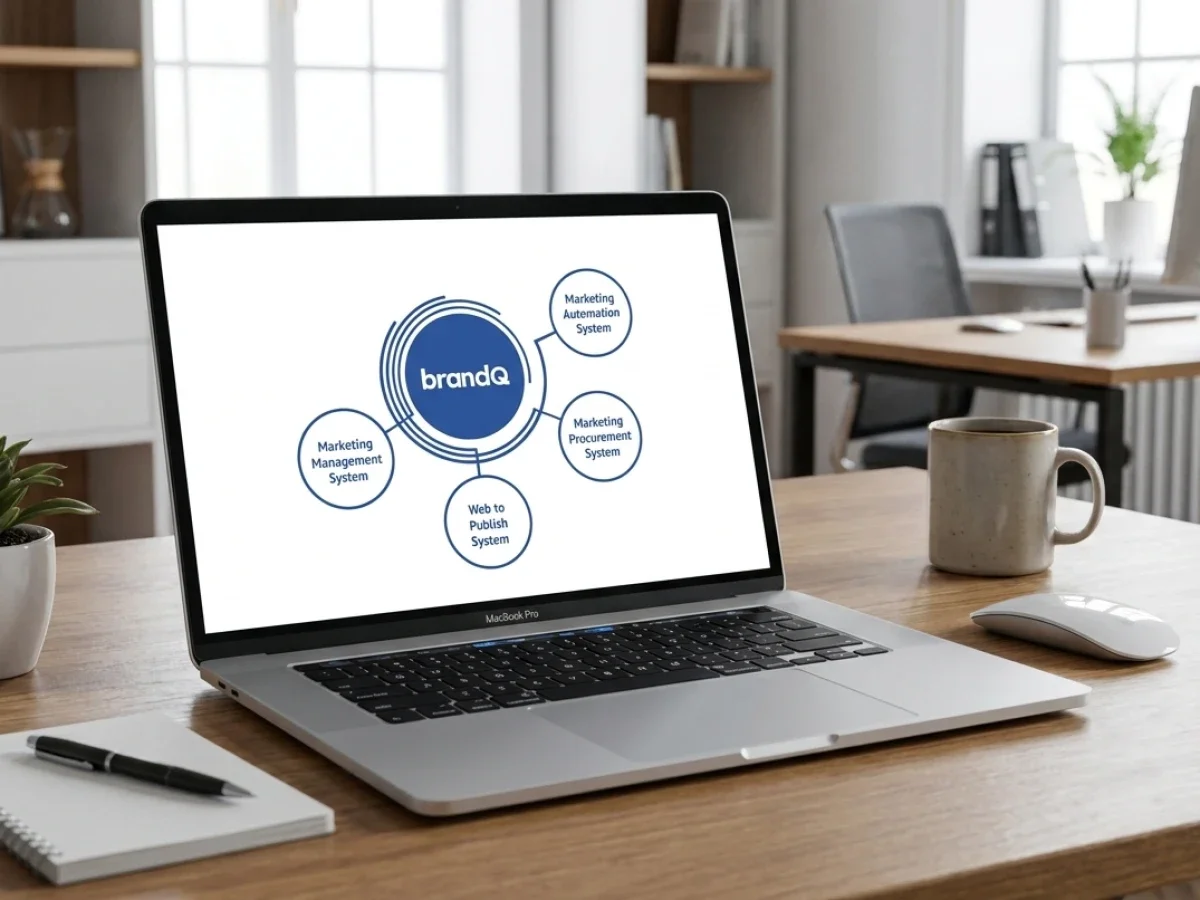
brandQ was developed specifically to address this level of organizational complexity. Rather than functioning as a standalone Brand Portal, it brings together Brand Portals, Marketing Resource Management, Digital Asset Management, Campaign Management, Marketing Automation, Event Management, Marketing Procurement, and Corporate Design Governance within one integrated Enterprise Brand Management Platform.
This integrated approach changes the way organizations collaborate. Brand managers gain complete visibility into asset usage, approvals, localization activities, and rollout progress. Marketing departments spend less time answering operational requests because users can access approved resources independently through structured Brand Portals. Sales organizations, franchise partners, agencies, and international business units receive role-based access to the materials relevant to their responsibilities while remaining fully aligned with Corporate Design standards.
The platform is equally well suited for complex organizational structures. Multi-Brand Management enables different brands to operate independently while following shared governance principles. Multi-Country Management supports localized communication without sacrificing consistency, while multi-client structures allow subsidiaries, business units, and regional organizations to collaborate within the same platform while maintaining clearly separated workspaces.
Because governance, collaboration, and execution are connected in one environment, organizations can scale their marketing operations internationally without increasing administrative effort at the same pace.
Creating a Brand Experience That Every Location Can Deliver
As organizations continue to expand, maintaining a consistent brand becomes less about enforcing guidelines and more about enabling collaboration. Every new office, partner, distributor, franchise, or regional marketing team increases the need for reliable processes that combine centralized governance with decentralized execution.
A modern Brand Portal provides exactly this foundation. Instead of relying on disconnected storage systems and manual coordination, organizations create a structured environment where assets, templates, approvals, campaigns, and responsibilities are connected from the outset. Marketing teams spend less time managing operational complexity and more time creating effective campaigns that support business growth.
As an Enterprise Brand Management Platform, brandQ combines Brand Portals, Marketing Resource Management, Digital Asset Management, Marketing Automation, Campaign Management, Corporate Design Governance, Marketing Procurement, Event Management, and flexible Approval Workflows into one scalable solution. This enables organizations to deliver approved marketing materials efficiently across branches, partner networks, international markets, and franchise systems while maintaining complete transparency and consistent Corporate Design.
Brand Portasl are far more than a central repository for marketing files. It creates the operational foundation that enables organizations to provide branches, franchise partners, distributors, agencies, and international teams with approved marketing materials while maintaining Corporate Design compliance.
CloudLabs brandQ combines Brand Portals with Marketing Resource Management, Digital Asset Management, Campaign Management, Marketing Automation, Corporate Design Governance, Marketing Procurement, and Event Management in one Enterprise Brand Management Platform. The result is a scalable environment that connects governance, collaboration, and marketing execution across every location, market, and partner organization.