.svg)

Marketing Management System with Automation: Connecting Print, Email, and Web to Publish in One Enterprise Workflow
Enterprise marketing no longer consists of isolated campaigns delivered through a single channel. Today's organizations coordinate printed collateral, email campaigns, digital advertising, sales presentations, event materials, social media assets, localized marketing content, and Web to Publish applications simultaneously. Every campaign requires collaboration between marketing, corporate communications, procurement, sales, IT, agencies, and local business units. The challenge is not creating marketing materials—it is ensuring that every channel follows the same governance standards while remaining fast enough to support modern business requirements.
Many organizations still rely on a combination of disconnected systems to manage these activities. Campaign planning may happen in spreadsheets, assets are stored across multiple repositories, approvals are coordinated by email, print materials are handled through separate ordering processes, while email marketing and Web to Publish operate independently. Each individual system performs its own task reasonably well, yet the overall marketing process remains fragmented. Teams spend unnecessary time searching for approved assets, coordinating approvals, adapting outdated templates, and manually transferring information between systems.
This fragmented approach becomes increasingly difficult as organizations expand internationally, introduce additional brands, support franchise partners, or operate large retail and sales networks. Every new market introduces additional stakeholders, languages, approval requirements, and localization needs. Without a central governance model, marketing complexity grows faster than operational efficiency.
A modern marketing management system addresses this challenge by connecting every stage of the marketing lifecycle. Instead of treating print, email, digital campaigns, Web to Publish, asset management, and approvals as separate activities, they become components of one governed workflow. Marketing teams gain transparency across campaigns, local users receive access to approved materials, and management obtains reliable visibility into campaign execution across the organization.
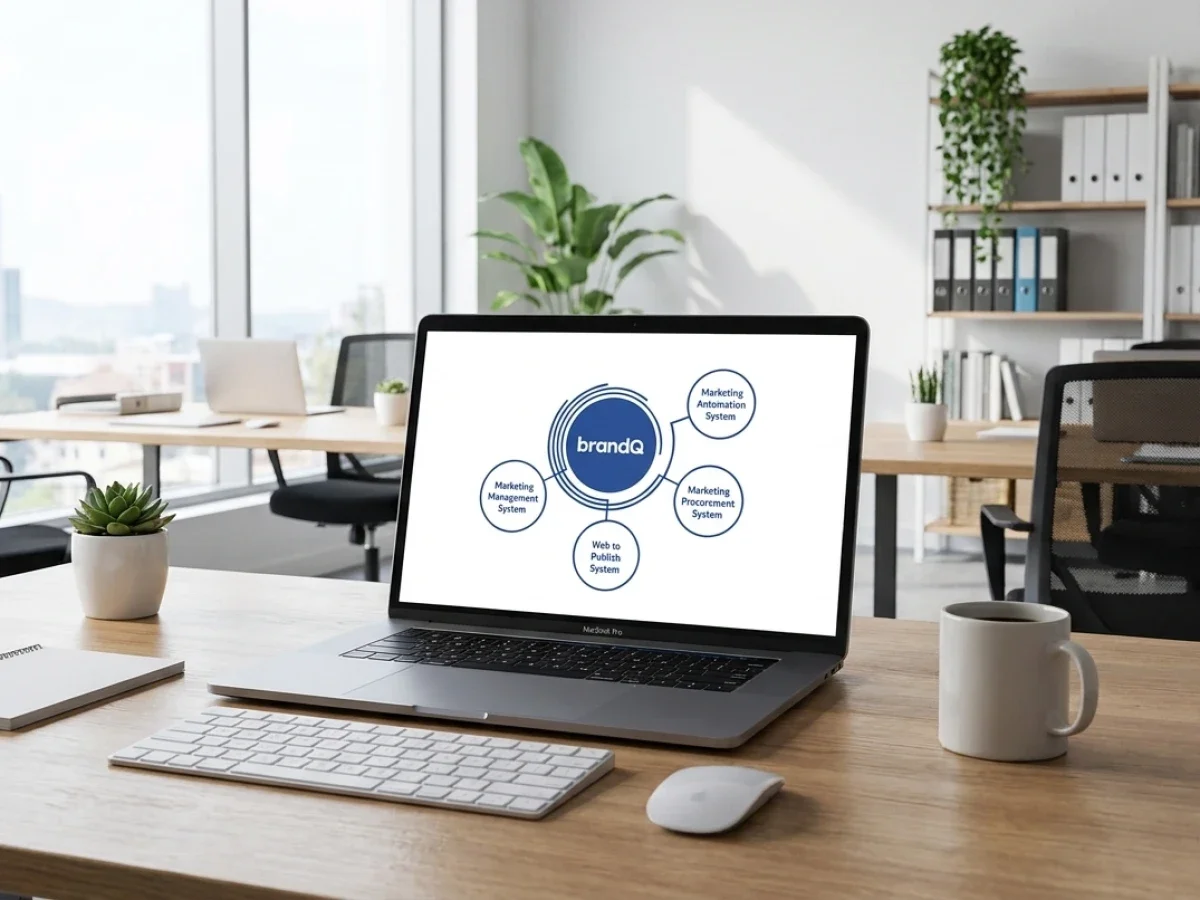
As an Enterprise Brand Management Platform, brandQ combines Marketing Resource Management, Digital Asset Management, Campaign Management, Marketing Automation, Brand Portals, Corporate Design Governance, approval workflows, marketing procurement, localization, and API integrations within one scalable platform. Rather than introducing another isolated marketing application, brandQ creates the operational foundation that connects strategy, execution, governance, and automation across all marketing channels.
In this guide, we examine why integrated marketing workflows are becoming essential for enterprise organizations, which challenges they solve, how they compare to traditional marketing processes, and how organizations can successfully implement a centralized marketing operating model.
Marketing Management System as the Foundation for Connected Enterprise Marketing
Marketing departments are expected to produce more campaigns than ever before while maintaining consistent branding across an increasing number of communication channels. Print catalogues, digital brochures, email newsletters, event invitations, sales presentations, point-of-sale materials, localized advertisements, and online content must all reflect the same Corporate Design while supporting different audiences and regional requirements.
This level of coordination cannot be achieved through isolated tools alone. Every marketing activity depends on access to approved assets, clearly defined responsibilities, structured approvals, campaign planning, localization, and reliable distribution. When these activities are disconnected, employees spend valuable time coordinating rather than creating.
An integrated marketing management system creates one operational environment for all marketing stakeholders. Marketing teams can manage campaigns from planning through publication. Local business units receive governed access to templates and assets. Procurement coordinates production through standardized processes. IT supports one scalable platform instead of maintaining numerous disconnected applications.
A comprehensive enterprise solution should combine:
- Marketing Resource Management for planning, budgets, procurement, and project coordination
- Digital Asset Management for structured asset organization
- Brand Portals for internal and external collaboration
- Campaign Management across print and digital channels
- Marketing Automation to reduce manual coordination
- Corporate Design Governance through controlled templates
- Approval workflows across departments
- Web to Publish capabilities for localized marketing materials
- API integrations with existing enterprise systems
- Multi-Brand and Multi-Country Management
- SaaS or Enterprise deployment options
When these capabilities operate within one platform, organizations gain significantly more than operational efficiency. They establish a repeatable governance model that supports sustainable marketing growth while allowing decentralized teams to execute campaigns independently within predefined rules.

The Challenges of Managing Print, Email, and Web to Publish Separately
How can organizations eliminate fragmented marketing processes and inconsistent brand communication?
The main challenge is that disconnected marketing channels create disconnected governance. When print production, email campaigns, Web to Publish applications, digital assets, and campaign planning are managed independently, organizations lose transparency over approvals, content versions, responsibilities, and brand compliance. A centralized marketing management system replaces isolated workflows with one governed process that supports every communication channel.
Many organizations experience this gradually rather than all at once. Marketing teams may prepare email campaigns in one application, manage brochures in shared folders, coordinate print production through external suppliers, and provide editable templates via separate Web to Publish tools. Each process functions independently, but none of them shares a common governance model.
The consequences extend beyond inconsistent branding. Marketing departments spend increasing amounts of time answering repetitive requests for templates and assets. Sales teams unknowingly distribute outdated brochures. Local offices adapt materials outside Corporate Design guidelines because approved resources are difficult to locate. Agencies receive conflicting artwork versions, while procurement coordinates production without visibility into campaign priorities. Executive management often lacks a consolidated overview of campaign status because information is distributed across multiple systems.
The absence of standardized workflows also creates operational delays. Approvals frequently move between Brand Management, Product Marketing, Legal, Corporate Communications, Procurement, and local marketing teams through email. Nobody has a complete view of review status, version history, or pending decisions. Small changes often trigger additional manual coordination, increasing campaign lead times while reducing transparency.
brandQ addresses these challenges by bringing campaign planning, Marketing Automation, Brand Portals, Digital Asset Management, approval workflows, and Web to Publish capabilities together within one platform. Rather than managing print, email, and digital communication separately, organizations establish one governance framework that supports every marketing activity. Assets remain centrally maintained, templates are always current, approvals follow predefined workflows, and every stakeholder works with the same trusted information.
Choosing the Right Marketing Management System
Which organizations benefit most from an enterprise marketing management system like brandQ?
brandQ is a strong fit when organizations need to coordinate marketing activities across multiple departments, countries, brands, franchise networks, retail organizations, agencies, or sales partners while maintaining centralized governance and enabling decentralized execution.
Enterprise marketing rarely struggles because campaigns cannot be created. The challenge is coordinating campaigns efficiently across large organizational structures. Headquarters must define Corporate Design standards, campaign strategies, and governance rules, while local teams require enough flexibility to adapt approved materials for regional markets, languages, or customer groups.
An enterprise marketing management system should therefore provide more than campaign planning. It should combine Brand Portals, Marketing Resource Management, Digital Asset Management, Campaign Management, Corporate Design Governance, Marketing Automation, approval workflows, localization, and role-based permissions within one scalable environment.
brandQ supports exactly this operating model. Headquarters maintains strategic control through centrally managed templates, assets, workflows, and governance policies. At the same time, local marketing teams, franchise partners, retailers, distributors, and agencies can access approved resources through personalized Brand Portals without compromising Corporate Design compliance.
Organizations particularly benefit when they operate:
- Multiple brands with different governance requirements
- International marketing organizations
- Franchise systems
- Retail and branch networks
- Regional sales organizations
- Agency ecosystems
- Large marketing asset libraries
- Complex approval processes
- Multi-country campaign structures
- Shared marketing service organizations
The platform's API-first architecture also enables integration with existing enterprise applications, allowing organizations to connect ERP systems, CRM platforms, authentication services, Product Information Management solutions, procurement systems, and reporting environments without creating additional data silos. This enables brandQ to become the operational foundation for enterprise marketing rather than another disconnected application.
Comparing Traditional Marketing Processes with an Integrated Platform
How does an integrated marketing management system compare to disconnected marketing tools?
The decisive factor is whether an organization wants to coordinate marketing through isolated applications or through one integrated governance platform.
Shared drives provide convenient document storage but offer limited support for permissions, approval status, lifecycle management, metadata, or Corporate Design compliance. Brand Portals extend far beyond file access by distributing approved marketing materials to the correct audiences while ensuring users always work with current versions.
A standalone Digital Asset Management solution focuses primarily on storing and organizing files. A comprehensive marketing management system builds on that foundation by connecting assets with campaign planning, localization, procurement, approval workflows, budgets, and Marketing Automation. Instead of simply finding assets faster, organizations manage how those assets move through the complete marketing lifecycle.
Manual approvals rely heavily on email communication and personal coordination. As the number of reviewers increases, transparency decreases. Automated approval workflows document every decision, route content to the correct stakeholders, send notifications automatically, and reduce administrative effort while improving accountability.
Decentralized asset management provides local flexibility but frequently leads to duplicate content, outdated materials, inconsistent branding, and reduced governance. Purely centralized control, however, often slows campaign execution. A balanced governance model combines central standards with controlled local execution so regional teams remain productive without compromising brand consistency.
Finally, isolated marketing tools generally solve individual operational challenges while creating additional interfaces between departments. Integrated platforms consolidate campaigns, assets, approvals, procurement, templates, localization, and reporting within one operational environment. This improves transparency across marketing while reducing coordination effort between departments.
brandQ supports this integrated approach by combining Marketing Resource Management, Digital Asset Management, Campaign Management, Marketing Automation, Brand Portals, Corporate Design Governance, marketing procurement, and flexible workflows into one enterprise platform.

Implementing an Integrated Marketing Management System
How should organizations implement a marketing management system successfully?
A scalable setup should include clearly defined governance, standardized workflows, structured assets, phased implementation, and close collaboration between marketing, IT, procurement, and executive leadership.
Successful implementation begins with understanding existing marketing operations rather than configuring software immediately. Organizations should analyze campaign planning processes, approval structures, procurement workflows, existing asset repositories, and current system integrations. This creates a realistic picture of operational complexity and identifies the processes that benefit most from automation.
The next phase focuses on governance. User roles, approval responsibilities, Corporate Design ownership, localization rules, and permission structures should be documented before workflows are implemented. Clear governance prevents uncertainty later and provides a consistent operational model for both headquarters and decentralized users.
Marketing assets should then be reorganized into a structured Digital Asset Management environment using consistent metadata, lifecycle management, taxonomy, and version control. High-quality asset organization forms the basis for efficient Brand Portals, campaign planning, and automation.
Organizations can then establish Brand Portals tailored to specific audiences. Internal marketing departments, sales organizations, agencies, distributors, franchise partners, and regional marketing teams each receive interfaces appropriate to their responsibilities. This simplifies user adoption while strengthening governance because each audience only accesses relevant resources.
Approval workflows should reflect real business processes rather than generic templates. Brand Management, Legal, Procurement, Corporate Communications, Product Marketing, and regional teams often participate in different approval stages. Automated workflows ensure every campaign follows the correct review sequence while reducing manual coordination.
Integration with existing enterprise systems should follow next. Connecting ERP platforms, CRM systems, Product Information Management solutions, authentication services, and analytics environments creates a unified marketing ecosystem that minimizes duplicate data and supports long-term scalability.
Most organizations achieve the best results by starting with a pilot project before expanding globally. Testing workflows with representative business units allows governance rules and user experiences to be refined before the platform is rolled out across additional brands, countries, or organizational units.
Building an Automated Enterprise Marketing Workflow
How can organizations connect print, email, and Web to Publish step by step?
Start with documenting every marketing channel currently used, including print production, email marketing, Web to Publish, digital campaigns, events, and sales communication. Identify where manual handovers occur and where duplicated work slows campaign delivery.
Define governance before technology. Establish who owns campaign planning, Corporate Design, approvals, localization, procurement, and final publication. Clear ownership ensures automation supports business processes rather than replacing them.
Organize marketing assets in one structured repository with consistent metadata, approval status, lifecycle management, and version control. This enables every campaign to draw from a trusted source of approved content.
Automate repetitive workflows including campaign requests, approvals, notifications, template generation, localization reviews, print ordering, and asset distribution. Automation reduces administrative effort while improving process transparency.
Connect the platform with existing enterprise applications using API integrations. CRM systems, ERP platforms, authentication services, procurement solutions, analytics tools, and Product Information Management environments should all exchange data without manual intervention.
Test the complete workflow using real campaigns before expanding organization-wide. Validate permissions, Brand Portals, approval sequences, localization rules, print production processes, email distribution, and Web to Publish functionality with representative users from every department.
Scale the platform gradually across brands, countries, franchise organizations, retail networks, agencies, and business units. Because governance structures are already established, expansion becomes predictable, efficient, and sustainable.
brandQ in Practice
Organizations typically implement brandQ because they want to simplify complex marketing operations rather than replace a single application. As campaigns become increasingly omnichannel, the platform provides one centralized environment where planning, assets, approvals, procurement, localization, and distribution are connected through standardized workflows.
An international manufacturer can coordinate product launches across numerous countries while allowing local marketing teams to personalize approved templates through Web to Publish without violating Corporate Design standards. Regional organizations receive the flexibility they need, while headquarters maintains strategic oversight.
Franchiseorganisationer kan distribuera godkänt marknadsföringsmaterial via varumärkesportaler, vilket gör det möjligt för franchisepartners att skapa lokaliserade kampanjer utifrån centralt styrda mallar. Detaljhandelsorganisationer kan standardisera inköp av marknadsföring och beställning av kampanjmaterial, samtidigt som enskilda butiker får snabb tillgång till aktuellt kampanjmaterial.
Eftersom brandQ kombinerar Marketing Resource Management, Digital Asset Management, kampanjhantering, marknadsföringsautomation, eventhantering, varumärkesportaler, lokalisering, godkännandeflöden, inköp och API-integrationer samt hantering av flera varumärken i en och samma plattform, kan organisationer skapa en heltäckande modell för marknadsföringsstyrning som stödjer långsiktig tillväxt istället för att bara lösa isolerade operativa problem.
Att bygga en framtidssäker marknadsorganisation för storföretag
I takt med att marknadsföring inom storföretag blir alltmer decentraliserad och flerkanalig krävs mer än bara enskilda marknadsföringsverktyg. Organisationer behöver en operativ plattform som kopplar samman kampanjplanering, tillgångar, godkännanden, tryckproduktion, e-postkommunikation, Web to Publish, inköp och styrning i ett skalbart arbetsflöde.
Ett modernt marknadsföringssystem möjliggör precis denna transformation. Istället för att samordna fristående aktiviteter i flera olika applikationer kan organisationer etablera standardiserade processer som ökar transparensen, minskar manuellt arbete, stärker efterlevnaden av företagets grafiska profil och påskyndar kampanjgenomförandet i varje affärsenhet.
brandQ stödjer denna utveckling genom att kombinera Marketing Resource Management, Digital Asset Management, varumärkesportaler, kampanjhantering, marknadsföringsautomation, styrning av grafisk profil, lokalisering och flexibla arbetsflöden i en plattform för varumärkeshantering. Detta gör det möjligt för organisationer att upprätthålla central styrning samtidigt som decentraliserade team får friheten att genomföra marknadsföringsaktiviteter effektivt, konsekvent och i internationell skala.
Marknadsföring inom storföretag är i allt högre grad beroende av sammanlänkade arbetsflöden snarare än isolerade verktyg. Ett modernt marknadsföringssystem integrerar kampanjplanering, Digital Asset Management, varumärkesportaler, Web to Publish, marknadsföringsautomation, godkännandeflöden, inköp och lokalisering i en styrd plattform. CloudLabs brandQ tillhandahåller denna integrerade driftsmodell och hjälper komplexa organisationer att standardisera marknadsföringsprocesser, förbättra samarbetet och skala upp konsekvent varumärkeskommunikation över avdelningar, länder och partnernätverk.